
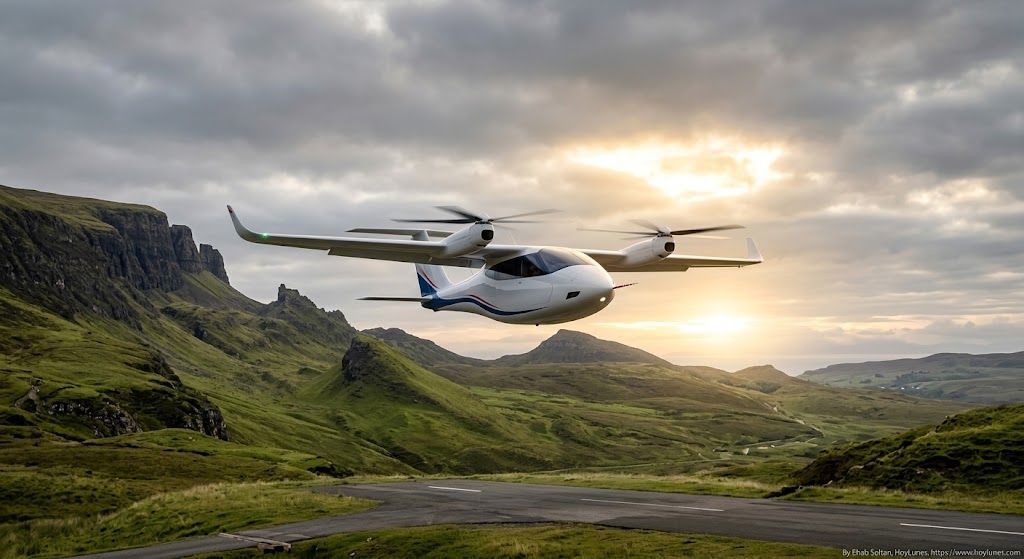
Scotland has become one of the testing grounds for evaluating a new way of connecting isolated territories. However, the future of electric aviation will depend not only on the aircraft, but also on **batteries, infrastructure, certification, and the economics of each route.
By Ehab Soltan
HoyLunes – A small aircraft carries out maneuvers at a regional airfield in Scotland. Around it, the fragmented geography of northern Britain serves as a reminder that, in these latitudes, aviation is neither a luxury nor merely a fast alternative to the train: it is an essential part of the connectivity infrastructure that holds island communities together, delivers mail, and guarantees access to basic services. When that aircraft takes off during an operational test, it does so powered by electric engines and with zero direct CO₂ emissions during flight.
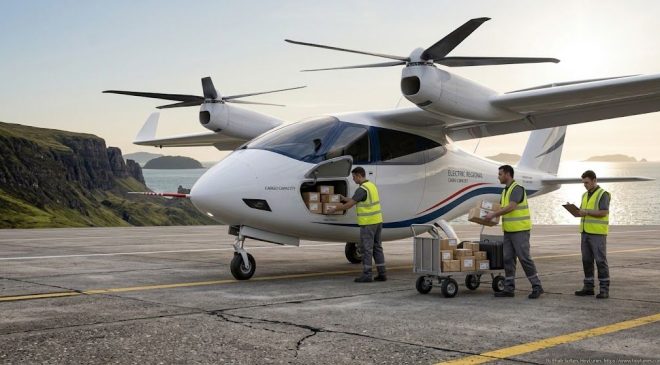
However, the most analytically revealing scene does not occur in the air, but on the cargo ramp and in ground operations. The underlying issue transcends the transport vehicle itself: it is a matter of evaluating what happens when electricity seeks to integrate into the daily operational network of isolated territories. The electrification of regional aviation has begun to leave design centers to face the demands, logistics, and schedules of real commercial transport.
Loganair Is Not Buying an Idea
For years, much of the debate surrounding sustainable aviation has developed around prototypes and laboratory demonstrations. The Scottish regional airline Loganair has taken a step toward commercial application by signing an agreement with the American firm BETA Technologies for the acquisition of five fully electric ALIA CX300 conventional takeoff and landing (CTOL) aircraft, with an option to incorporate five additional units.
The project sets 2029 as the estimated horizon for entry into service, a timeline subject to obtaining the corresponding aeronautical certifications and regulatory approvals. The significance of the announcement lies in the prior trials supporting it: in 2026, according to data provided by the European Regions Airline Association (ERAA), both companies conducted an electric aviation demonstration program in the United Kingdom. Over 10 days, 23 test flights were completed, totaling more than 1,000 nautical miles across a network connecting Glasgow, Dundee, Aberdeen, Inverness, Wick, and Kirkwall.
Those operations were not limited to verifying the flight capabilities of the aircraft. They also evaluated integration with Royal Mail postal services, cargo handling, and system performance within existing airport infrastructure. The difference between a prototype and a commercial operation lies not merely in taking off, but in the ability to repeat the process with regularity, safety, and under the real operating conditions of a regional airline.
Not All Skies Need the Same Aircraft
To analyze why Scotland has become one of the settings for this trial, it is necessary to examine its map. Regional aviation operates in this environment under distinct dynamics: short distances, frequent operations on specific routes, low demand density, and strong territorial dependence in geographies where constructing ground infrastructure is geologically complex or economically unviable.
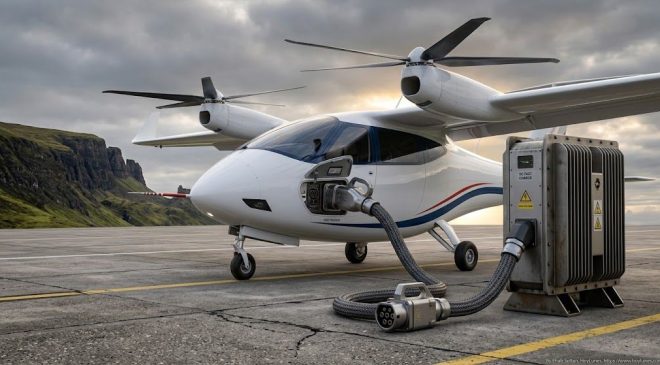
The ALIA CX300 is designed for short-haul regional missions. With capacity for up to five passengers or 567 kilograms of cargo, the aircraft operates on conventional runways, eliminating the need to construct dedicated vertiport-style facilities. According to specifications from manufacturer BETA Technologies, the model enables fast ground recharging adaptable to operational turnarounds, depending on the charging point configuration and battery state.
The initial commercial applications of electric aviation are unlikely to occur on major long-haul routes, but rather where distances and territorial connectivity needs align with current technical limitations. The Scottish regional network offers a particularly suitable setting to test the viability of these transport models.
What if the Aircraft Was Not the Main Problem?
The development of electric aircraft continues to face significant engineering and certification challenges. Even so, the viability of an electric route depends on an interconnected chain of factors where a failure in any link can restrict or prevent commercial operation:
Aircraft ➔ Battery ➔ Charging Point ➔ Power Grid ➔ Operations & Maintenance ➔ Certification ➔ Route Economics
On the financial side, Loganair leadership has indicated that it expects operating cost reductions of up to 80% compared to traditional combustion engines, based on the lower mechanical complexity of electric propulsion systems and energy efficiency per route. However, this calculation remains within the realm of corporate expectations for now. Its confirmation will depend on actual battery lifecycle costs, peak electricity supply tariffs, and the maintenance cost structure set by aeronautical authorities.
Energy Density Limits Range
One of the primary current limitations for aerial electrification lies in the energy density of batteries. Conventional aviation fuel stores significantly more energy per unit of weight than commercially available lithium-ion batteries. Furthermore, unlike a combustion aircraft, which reduces its mass as it consumes fuel, the mass of batteries remains constant throughout the entire flight.
This technical characteristic constrains the aircraft’s payload and range. The energy reserve margins required by regulations to address potential diversions or adverse weather further reduce the effective range available for commercial routes. Consequently, initial electric aviation does not aim to replace the conventional medium- or long-haul fleet, but rather to operate in niche markets where its limitations are compatible with service needs.
Ground Infrastructure Must Also Transform
Introducing electric aircraft into regional networks requires adapting airport infrastructure. While conventional operations rely primarily on aviation fuel supply, servicing electric aircraft demands charging points capable of delivering high power without compromising the stability of the local electrical grid, as well as specific protocols for managing battery thermal risk.
On the regulatory front, the European Union Aviation Safety Agency (EASA) has been updating its regulatory framework to respond to the introduction of electric and hybrid propulsion technologies. These regulatory shifts address aspects related to airworthiness, maintenance, and technical personnel training. The sector’s energy transition therefore demands the simultaneous development of regulatory frameworks, technical capacity, and ground facilities.
The European Institutional Context
Loganair’s initiative falls within a broader trend across the European aerospace sector. The European Commission launched the Alliance for Zero Emission Aviation (AZEA), a forum bringing together more than 200 aviation ecosystem organizations that has worked on strategic roadmaps to facilitate the entry into service of hybrid and electric aircraft.
In turn, European initiatives such as the ERA project focus on developing clean propulsion technologies for regional aviation, aiming to contribute to scalable technologies for higher-capacity aircraft in the future. The Scottish project constitutes one of the first cases where these institutional guidelines and technological developments translate into a test plan within a commercial airline.
A demonstration flight answers the question “can it fly?” A commercial route answers a much harder one: “can it do so every day and make money?”
The electric aviation sector is abandoning prototypes to face the real market. Taking Loganair’s trial in Scotland as a starting point, we analyze technical challenges, airport infrastructure, EASA regulation, and keys for its eventual development on regional routes.
Scenario Analysis in the Spanish Context
The debate on electric aerial mobility raises questions regarding its eventual application in other European countries, such as Spain. Rather than assuming immediate adoption, Spanish geography presents scenarios that warrant examination as potential analytical fields:
- Island connectivity: Specific short-distance connections in the Canary and Balearic archipelagos display geographic characteristics that justify studying direct zero-emission models, provided range profiles, required reserves, and payload capacities match real demand.
- Logistics and light freight transport: The distribution of smaller goods or priority shipments between the mainland and island or hard-to-reach areas constitutes a hypothetical testing scenario where passenger requirements do not dictate operations.
- Airport infrastructure: The network of regional airfields and airports managed in Spain offers facilities that could evaluate the progressive implementation of electric charging points should commercial models consolidate.
The Scottish case does not permit the conclusion that the technology is directly or immediately transferable to other environments, but it does offer a reference framework to evaluate what types of routes and territories might analyze similar solutions in the future.
Technical and Financial Viability
Evaluating the real impact of electric aviation requires weighing its possibilities against its current technical and economic constraints:
| Potential Advantages | Obstacles and Constraints |
| Zero direct CO₂ emissions during the flight phase. | Limited range due to battery energy density. |
| Noise reduction during takeoffs and approaches. | Investment required in airport charging infrastructure. |
| Lower mechanical complexity in engine maintenance. | Uncertainty regarding battery lifecycle and replacement costs. |
| Potential reinforcement of specific low-demand regional routes. | Stringent regulatory demands and prolonged certification processes. |
Every potential advantage is subject to resolving its corresponding operational limitations. **Environmental viability does not automatically guarantee economic sustainability** if the amortization of ground equipment and the cost of available energy increase overall operating expenses.
Evaluation in the Commercial Network
If the five ALIA CX300 aircraft are ultimately integrated into Loganair’s commercial fleet, the initiative will transition to evaluation under real market conditions. The system will have to respond to continuous schedules, passenger and cargo transport, winter weather conditions, and the financial profitability of commercial operations.
That environment will determine whether small-scale electric aviation has reached an applicable level of maturity or requires extended periods of technological development and financial support.
The true transition will not be consolidated when an electric aircraft performs a test flight, but when it manages to maintain regular operations, transport cargo and passengers safely, and demonstrate the economic viability of the route.
The development of electric aviation may not begin with the immediate replacement of large commercial airliners, but through more bounded applications: connecting a remote community or servicing small airfields using aircraft adapted for short distances. The true transition will not be consolidated when an electric aircraft performs a test flight, but when it manages to maintain regular operations, transport cargo and passengers safely, and demonstrate the economic viability of the route it serves.